Book summary of a| 60 second leadership| Chapter 24| Bookodidact

Hello, readers🙋Welcome back to the Bookodidact. A great place to read, learn and take notes. Let's get started with our chapter summary.

24. Unhappiness comes from Comparison

Book summary of a 60 second leadership, book summary of a, book summaries, libro,livro,kitap
Book summary of a 60 second leadership

Unhappiness comes from comparison 
Think about it. We do this all times. We compare houses, income, jobs, situations, conditions, etc. 

We all know that phrase "Keeping up with the Joneses".

Indirectly or directly we all fall into the state of comparison. The author is no exception.

Some comparison can be helpful if managed in a competitive and productive way.

The devil loves to get us comparing some else's best to our worst- pretty unfair fight.

If it's true that all of our unhappiness comes from comparison, then we have to start applying the opposite perspective.

Happiness comes from within.


Key Lessons:- The author advises us to stop comparing yourself with people if it is not helping you in a productive way. The real happiness lies within not from the outside comparison.

Conclusion:- Happiness comes from within. 

No outside comparison, just plain old internal perspective.

Share:

Book summary of a| 60 second leadership| Chapter 23| Bookodidact

Hello, readers🙋Welcome back to the Bookodidact. Let's get started with our chapter summary.

23. The Principle and the Lighthouse
Book summary of a 60 second leadership, book notes, book summary of a, booksummaries,libro,livro,kitap
Book summary of a 60 second leadership

At the beginning of the chapter, the author shares a transcript of a radio conversation between a US naval ship and Canadian authorities.

The title is based on that conversation. Although I can't share the conversation. You need to go buy the book and read it for yourself.

Disclaimer:- I am not getting paid for any such stuff 😉

Now, let's find out what the author is trying to say from the chapter.

Techniques can change but principle never does.

They are similar to the lighthouse, they don't change.

The author shares his experience while doing sales training. The common question he would get were all about techniques.

Eg:- How to approach? 
       What to say? 
       How to close?

All good stuff, but if it's done outside of principle it's often not very effective in the long term.

Now, let's try to figure out what principle means to the author. What's his definition?

What's the principle?

It's the "Why" behind the process.

They are unmoving resolute.

" If you know your why, you will figure out how"

My Thoughts:-  Dig deep within yourself and find what it is that will drive you when you have nothing left.

Call it passion, love, purpose, call it whatever you want to call it. I love to call it "Purpose". Your " Why" that's what will keep you going when you want to give up.

Know your "Why" and you will figure out "How"

Your "Why" evolve as you evolve.


Video Recommendation:- 


Book Recommendation:- 


Techniques does matter. It makes the process smoother and quicker. Don't discount it- get it, learn it, own it.

Key Lesson:- Principle is the foundation of a person's character. If the man has a strong principle bank on him. Technique built on strong principles that's a winning combination. 


Conclusion:- Bank on strong principles. 

                       Know your why. 

 Technique + Strong principles= Winning Formula 


Share:

Book summary of a| 60 second leadership| Chapter 22| Bookodidact

Hello, readers🙋 Welcome back to the Bookodidact. Now let's get to our chapter summary.

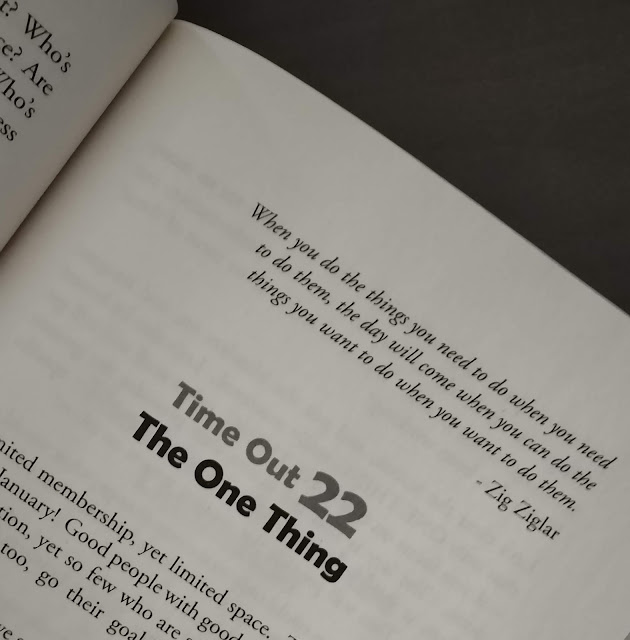
22. The One Thing
Book summary of a 60 second leadership, book notes, book reviews, book summary of a, libro,livro,kitap
Book summary of a 60 second leadership

We are so distracted by the trivialities in life that we lose focus on what's important. We tend to take so much in our plate that we can't even digest.

While trying to do so much in a short amount of time, we hamper our own productivity. 

Take an example such as Resolution.

We all know "Resolution" and most of us make one at the start of a year. But how many of them we actually follow and keep up with.

We all know the answer. 

Have you ever wondered why is it so? 

Let's find out through the author. 

Typically, when we are ready to commit to change, we want to commit to too much change, which usually yields no change at all.

Now, let's go back to our resolutions chances are we have made so many of them and that's the problem.

Even Brian Tracy advised us on this topic.

He advised us that we choose the One Thing that if done effectively and consistently over the 90 days would have the greatest impact on our desired outcome.

Let's break it into a more practical way.

1) What do you want?


2) What should you be doing(1 thing) to get it?


Now, let's apply it in every area of our life.

How about your job, marriage, business, health? 

There are so many things we could do to improve our job performance, marriage, business, health.

Trying to tackle all or most of them?

How's that been working for you so far? 😉

Key Lesson:- In this chapter author advice us to clear the screen and focus on that "1 thing" that really mattered.

 As we focus on that "1 thing", other stuff will still get done.

 The key is that the action that provides the greatest return is fully leveraged, with consistency and very specific intent which will provide the greatest return on effect. 


Conclusion:- Focus on the 1 thing. 

Decide, execute for 90 days. 

Finish what you start and only then look back. 

The world is full of great starters. It's the finishers that are the ones to watch.

Share:

Book summary of a| 60 second leadership| Chapter 21| Bookodidact

Hello, readers🙋 Welcome back to the Bookodidact. Let's get started with the chapter.

21. Who, Where, Why

Book summary of a 60 second leadership, book summaries of a, book summary, book review, libro, livro, kitap
Book summary of a 60 second leadership

We all have heard about the saying that, Our income is the average income of the top 5 people we hang out with.

Although the author never really checked the validity of that statement he sure gets the context that it revolves around our habits.

Our habits which impact all the areas of our life.

Whoever those influencers are in our life, we should check their habits and their results against the most important parts of our life.

We should ask the following questions.
  • Do they have what I want where it matters most?
  • Are you willing to trade places with them on that particular thing?
My video recommendation on the topic:

Watch the video on Valuetainment titled "How to Choose a Mentor" - Seek Trifectas

In that video, the host of Valuetainment Mr Patrick Bet David explains how to choose a mentor which he called Trifectas.

He calls it a "T E A" theory

1) T -      Theory 

2) E  -      Experience

3) A-     Application

Go watch the whole video to learn more about the topic.

Also, keep in mind that our top influencers may not be through direct personal relationships.

We live in a time where information is at a peek of our hand. The Internet made it possible for us to get in contact with such people.

But, remember there are many other people who call themselves an expert without any credentials. Be aware of such people. Seek mentors(trifectas). Follow them through personal contact, books, interviews. 


Key Lesson:- In this chapter, the author encourages us to ask questions about our surroundings. Who are the people we must follow? He also asks us to find out the mentors who have been on a journey and gone through the things that we are going on. Seek such mentors with whom you can trade places in the near future. 


Conclusion:- Seek people who inspire you in a positive way. 

Seek trifecta mentor in all area of your life. 

Ask yourself are you willing to trade places with them in the near future? 

Do they have what you desire? 


Share:

Book summary of a| 60 second leadership| chapter 20| Bookodidact

Hello reader🙋

 Welcome back to the Bookodidact. Let's get started with the chapter summary.

20. The Crazy Cycle

Book summary of a 60 second leadership, book notes, book summary of a, libro, livro, kitap
Book summary of a 60 second leadership

Two negatives added together equals a negative. 

That's the crazy cycle. 

At some point, the crazy cycle needed to be turned around. 

Let's find out what the author is trying to say.

In high school, the author had an addiction. Not that type of addiction you may be thinking about😉

It was running. To him, it was a real habit. He would run daily, eating, on the other hand, was not stellar but, it didn't matter to him as he was young.

The author is not in high school anymore. He's married, has kids and a demanding job just like most of us.

All these reasons can become excellent excuses to stay in a crazy cycle. To the author, these are all reasons because that's what they should be.

We can influence our physical and mental condition. Our family, friends and careers are a good reason to be healthy. 

Aren't they????

To the author, the goal is not just living, it's living with vitality, energy and passion with more to give to those we love now and long term.

So, let's go there - it's the energizing cycle.

Now, you must have understood what crazy cycle he was talking about. It's all in perspective. Use your thinking in a more positive way. Don't let excuses hold you or stop you in moving forward in life.

Whether it's exercising when you think you are too old to do it or it's something else.

Key Lesson:- The author encourages us to move forward from the crazy cycle to the energy cycle. He wants us to see how we can, not why we can't. He wants us to use another mathematical principle instead of the previous one. 

Two positives added together equals a positive.


Conclusion:- Be stronger than your temporary emotions. 

See how we can, not why we can't. 

Go forward towards energizing cycle. 

Share:

Book summary of a| 60 second leadership| Chapter 19| Bookodidact

Hello readers🙋

Welcome back again🙏 let's get started with the chapter summary.

19. The Comfort of Change

Book summary of a 60 second leadership, book summaries, book reviews, libro, livro, kitap
Book summary of a 60 second leadership 

If change is comfortable, you are doing it wrong.

Above statement was said by the author's son when he was helping his father with serving(tennis sport).

Even the famous author "Robin Sharma" says something which he calls brain tattoo.

"All change is hard at the beginning, messy in middle and gorgeous at the end".

The only thing permanent in this life is change.

If you are not changing, you are dying.

Key Lesson:- Regardless of personal struggle with change, the advice given by the author's son is so true. 

How much change do we take on, only to adjust it to a more comfortable level? 

When we do this, we rob ourselves of real rewards that come from correct and consistent change. 

So, enjoy change and use it as a weapon to go to the next level in life.


Conclusion:- Change. Don't adjust to your level of comfort, keep it consistent with proper coaching and the ultimate reward is yours.

Share:

Book summary of a| 60 second leadership| Chapter 18| Bookodidact

Hello, reader🙋 welcome back. Let's get started with our chapter.

18. Takers, Traders, Investors

Book summary of a 60 second leadership, book notes , book summary of a , libro, livro, kitap
Book summary of a 60 second leadership 

The title is similar to one of our previous chapter summary titled "People Math". If you remember the summary of that chapter. You will understand what we talked about.

In this chapter, the author tries to give us a different outlook on the kind of people we have in our life. 
Don't forget to count yourself in 😉

According to this chapter, there are 3 types of people.
1) Takers 2) Traders 3) Investors 

1) Takers:- These are the people who generally take. They do not give and show up to receive. It's all about them.

2) Traders:- These are the people who give conditionally. They will help, but only if it will be reciprocated. They keep score and eventually, you will have to pay them in one form or another.

3) Investors:- These are the people who give and often receive. They don't plan or make receiving conditions. They invest in a relationship, cause and opportunity. They are unconditional and unselfish in nature. What they may receive may not guaranteed, not is the level of return.

Key Lesson:- The author encourages readers to be investors and give unconditionally. He advised us to invest in people, even ourselves.


Conclusion:- Give, to get, to give again. The best things are always built with the investor.

Share: